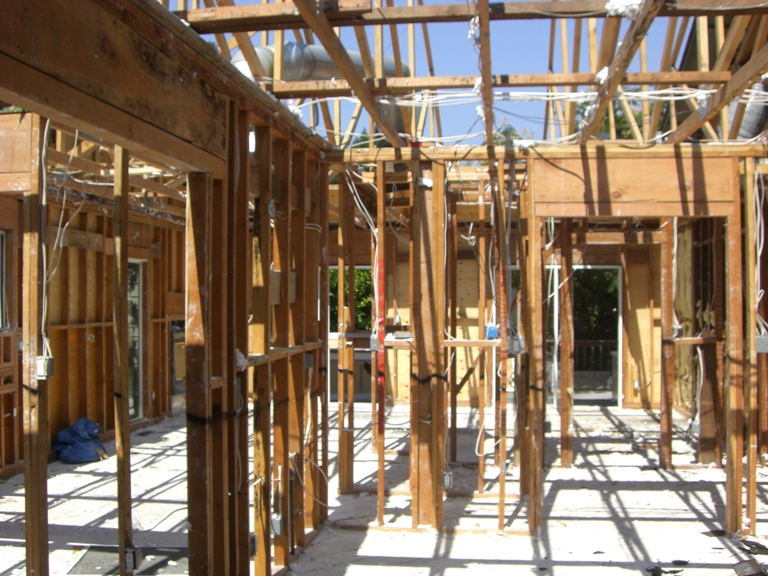
Selective demolition is targeted, careful demolition work: removing specific building components – walls, fixtures, finishes, mechanical systems – while preserving the structure and adjacent spaces around them. It is the standard scope when the building stays in place and only parts of it need to come out.
This is the most common form of demolition for remodels, additions, tenant improvements, and seismic retrofits. It is fundamentally different from complete demolition (whole structure comes down) and from deconstruction (hand-dismantle for donation). Picking the right scope matters – here is when selective demolition is the answer.
When selective demolition is the right scope
Residential remodels
You are renovating a kitchen down to studs. Or opening up a wall between the dining room and kitchen. Or pulling out a bathroom for a full retile. You want everything else in the house left untouched. Selective demolition is the scope.
Additions
You are adding a room or an ADU. The new construction ties into the existing structure at a specific wall. That wall has to come out (or get a new opening cut into it) without disturbing the rest of the house. Selective demolition.
Tenant improvements
A new tenant is moving into a retail or office space. The previous tenant’s build-out has to go – interior walls, finishes, dropped ceilings, fixtures, electrical, plumbing – but the shell of the building stays. Selective demolition is the entire scope of most tenant-improvement demo phases.
Seismic retrofits
The work is happening behind walls, in cripple walls, around foundation perimeters. Specific finishes have to be removed, work performed, and the structure rebuilt around it. Selective demolition opens the access.
Hazardous material remediation
Asbestos in a specific area, lead paint on certain surfaces, mold remediation in a wall cavity. Selective demolition isolates the affected area without disturbing surrounding building materials.
When selective demolition is NOT the right scope
- Whole structure coming down: use complete demolition
- Home has reusable materials and you want a donation receipt: use deconstruction
- Just removing fixtures or finishes that come out by hand: that may be normal contractor work, not “demolition” scope
What selective demolition actually includes
A typical Mavco selective demolition scope:
- Walk-through with the GC or architect to mark exactly what comes out
- Site protection – floor coverings, dust barriers, HVAC isolation, neighbor and tenant notification
- Disconnect of electrical, plumbing, mechanical in the demo area (often via the GC’s subs)
- Removal of finishes – flooring, drywall, ceiling, fixtures, cabinets, doors
- Removal of framing and structural components as specified
- Sorting of debris for recycling vs landfill
- Haul-off and final clean-up
- Handoff to the next trades
What selective demolition costs in the Bay Area
Most interior selective demolition runs $3-$8 per square foot in the Bay Area, depending on what is being removed, access constraints, and disposal requirements. Some real-world ranges:
| Project | Typical cost |
|---|---|
| Kitchen demo (down to studs) | $2,500-$5,500 |
| Master bath demo (down to studs) | $1,500-$3,500 |
| Full residential interior strip (3,000 sq ft) | $12,000-$25,000 |
| Open wall between two rooms | $800-$2,500 (depends on load-bearing) |
| Small retail TI demo (2,000 sq ft) | $8,000-$16,000 |
| Office TI demo (5,000 sq ft) | $20,000-$45,000 |
| Seismic retrofit access demo (cripple walls) | $1,500-$5,000 |
What drives the price within selective demolition
Load-bearing vs non-load-bearing
Removing a non-bearing partition wall is fast. Removing a load-bearing wall requires temporary shoring, structural engineering sign-off, and careful sequence. Same square footage can be 3x the price.
Mechanical, electrical, plumbing (MEP)
A wall with no utilities behind it goes fast. A wall containing electrical, plumbing, HVAC, or fire-sprinkler lines requires those trades to disconnect first. Coordinating MEP shutoffs adds time and cost.
Hazardous material
Pre-1981 buildings require asbestos testing on any material being demolished. If positive, abatement is required first. This can add days and significant cost.
Access
Top-floor units, tight elevators, after-hours requirements in occupied buildings. Each of these adds cost.
Dust control
For occupied tenant spaces and operating businesses, aggressive dust containment (negative-pressure HEPA, plastic barriers, floor-to-ceiling poly) is required and adds 10-20% to the demolition cost.
The after-hours premium
Many Bay Area tenant improvement demolitions happen at night or on weekends so the surrounding businesses or tenants are not disrupted. After-hours rates typically run 20-40% higher than daytime work but can be the only practical option for occupied buildings.
Permits for selective demolition
Most Bay Area cities require a building permit for any selective demolition involving structural changes, electrical, plumbing, or mechanical work. Cosmetic-only demo (finishes, cabinets, fixtures) may not require a permit but always coordinate with the GC’s overall permit set.
How selective demolition is sequenced
- Walk and mark: Mavco and the GC walk together, mark every wall, fixture, and component that comes out
- Pre-demo coordination: MEP shutoffs, hazmat testing if needed, neighbor/tenant notification
- Site protection: floor coverings, dust barriers, signage
- Soft demo: finishes, fixtures, cabinets, doors – the easy stuff
- Hard demo: framing, structural components, wall removal
- Debris sorting: recyclables, donation-eligible, landfill
- Final clean: broom-clean handoff to next trades
Common gotchas
- Discovering load-bearing where it was not expected. Some Bay Area homes have non-obvious load paths. Always have a structural engineer confirm before assuming a wall is non-bearing.
- Hidden plumbing or electrical in walls slated for demolition. Test before swinging.
- Asbestos in popcorn ceilings, pipe insulation, floor mastic in pre-1981 buildings.
- Hot work concerns when cutting near combustibles or in occupied buildings – some work requires a fire watch.
Working with Mavco
Mavco runs hundreds of selective demolition projects every year across the Bay Area – tenant improvements, kitchen and bath remodels, additions, seismic retrofit access, and hazmat-related work. We coordinate cleanly with general contractors, work after-hours when needed, and protect the surrounding building so other trades can pick up where we leave off.
See our selective demolition service or request a quote with a free walkthrough.